
TL;DR
In this lesson, students analyze required CED images to understand the historical significance of HBCUs before researching one institution in small groups. They then deliver a four-minute persuasive presentation designed to convince classmates to apply to their HBCU, blending source analysis, collaborative research, and comparison while maintaining strong alignment with the AP African American Studies curriculum.
Learning Objective (from CED)
Explain how the creation of historically Black colleges and universities (HBCUs) in the United States impacted the educational and professional lives of African Americans nationally and internationally.
Pre-work
Prior to this class period, students will have completed the #45 notes with the corresponding video found on https://www.apushslides.com/afam/unit3. This pre-work ensures that students enter the lesson with shared background knowledge, allowing class time to focus on analysis and synthesis rather than basic content acquisition.
Opening (20 minutes)
I start by analyzing the four photographs that are the required sources in this topic. The conversation should follow what the CED notes as the importance of HBCUs. I followed the order set by the essential knowledge points, rather than the chronology of the photograph.
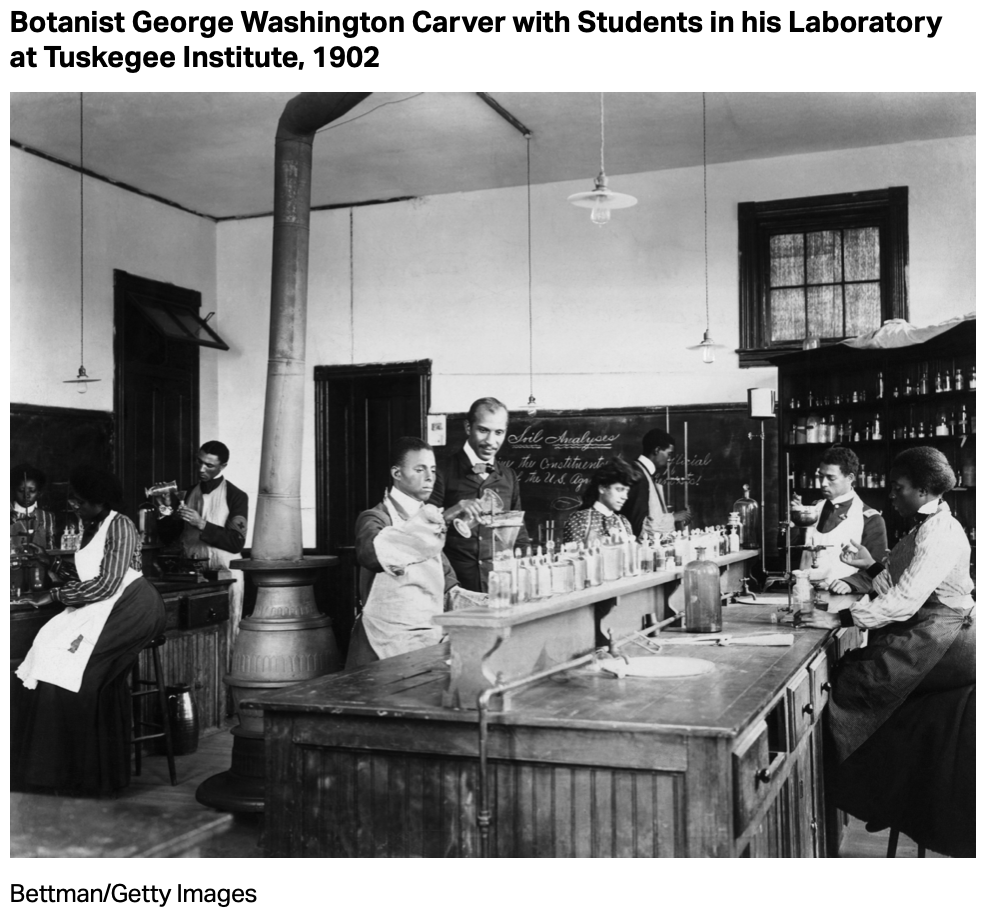
Contributions to science from HBCUs
I start with the photograph of George Washington Carver at Tuskegee. I start with the distinction of industrial education and liberal arts education. The CED has already introduced the Atlanta Compromise speech by this point and the lecture notes went over the rivalry between W.E.B. Du Bois and Booker T. Washington. But it’s important to emphasize that an Industrial education would be more similar with how students think about modern trade schools. With that emphasized, students may then be confused with the lab they see in the picture as they may associate those settings with more advanced education. However, George Washington Carver’s work on peanuts and this lab setting had the objective of improving farming methods, mainly, to restore nutrients into the soil in between cotton crops.
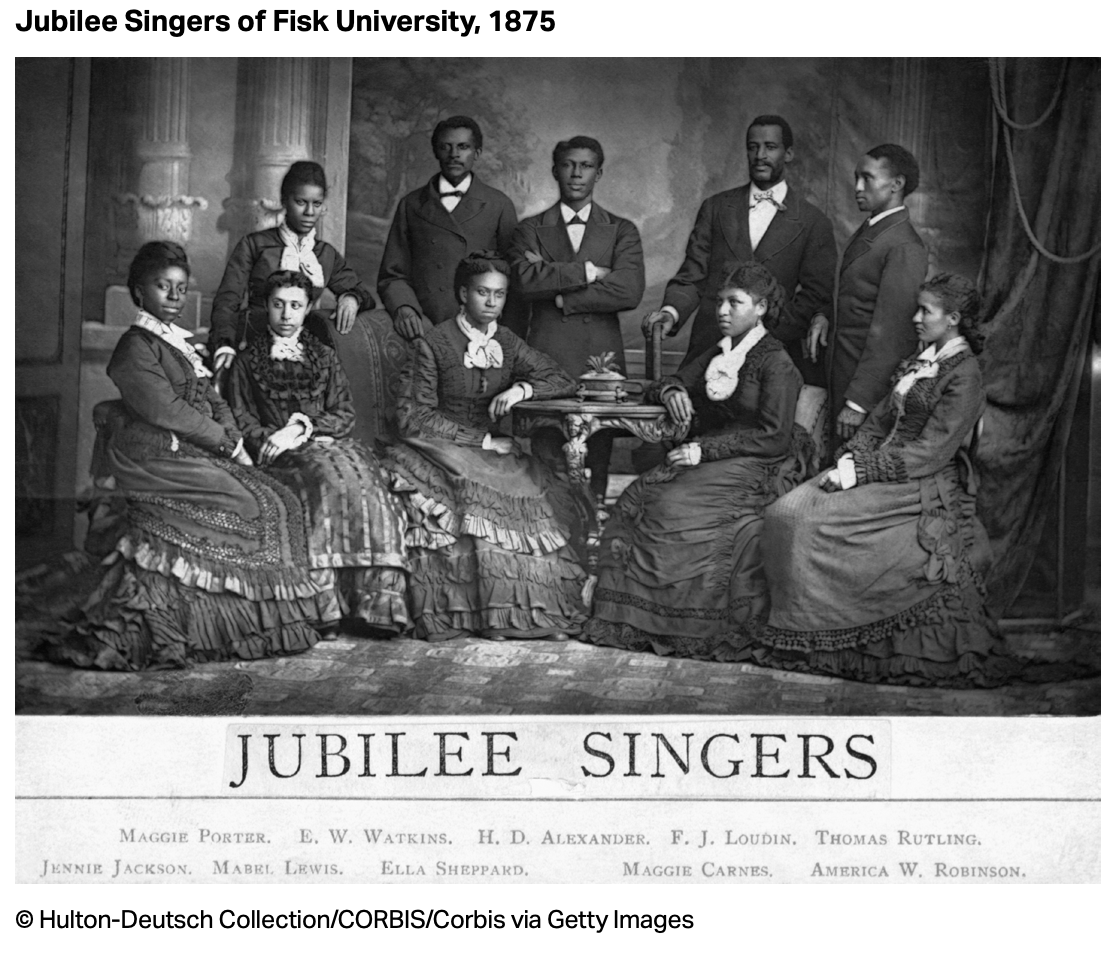
Cultural contributions of HBCUs
The Fisk Jubilee singers' photograph is what I use to emphasize the essential knowledge point that HBCUs created spaces for cultural pride, as well as the point that the Jubilee singers introduced the wider world to the musical tradition of African American spirituals. As a bonus I point out their clothing and poses in the portrait and tie it back to the photography topic from unit 2 and the most recent topic on women’s organizations. That’s because they are providing a serious and dignified image of African Americans to combat negative stereotypes, something that a previous topic has called the politics of respectability.
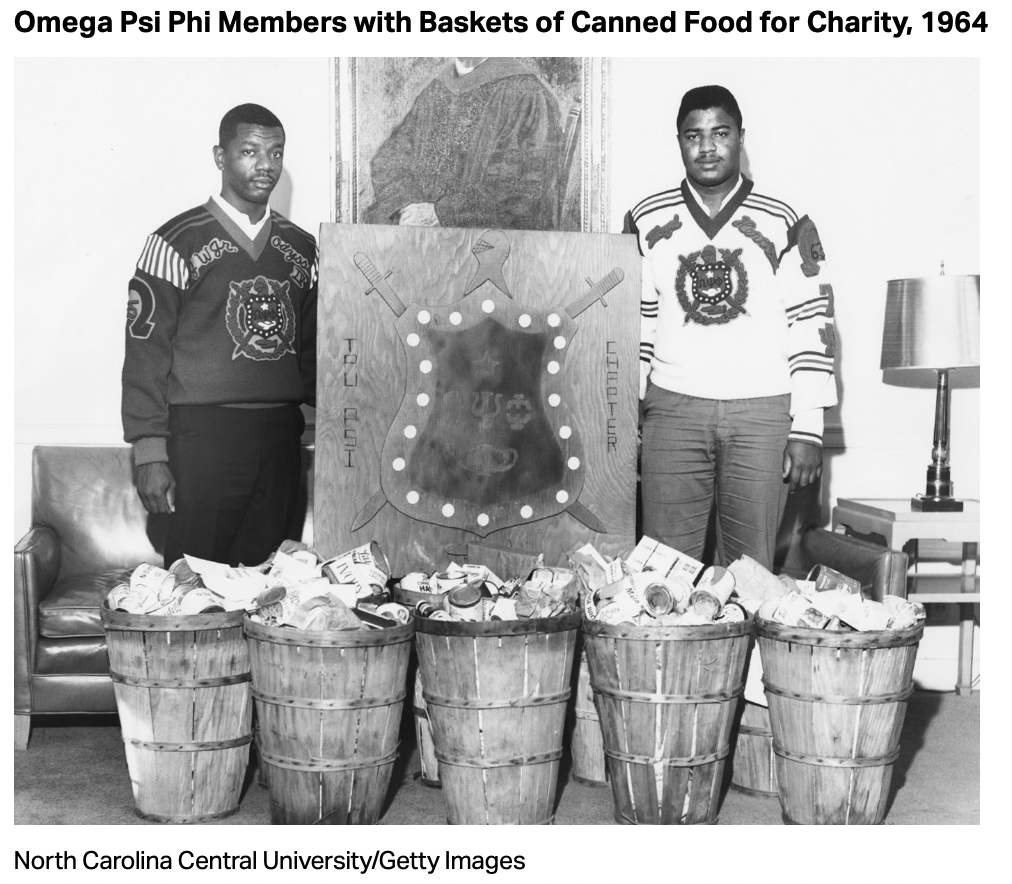
Impact and function of BGLOs
The Omega Psi Phi photo speaks to the essential knowledge point on Black Greek Letter Organizations (BGLOs). Their work in the canned food drive speaks to the community service aspect of their organization. While engaging in community service can help create a brotherhood or sisterhood bond I also bring in a short video example of a step show put on my a BGLO and we talk about how dance can help create a similar bond.
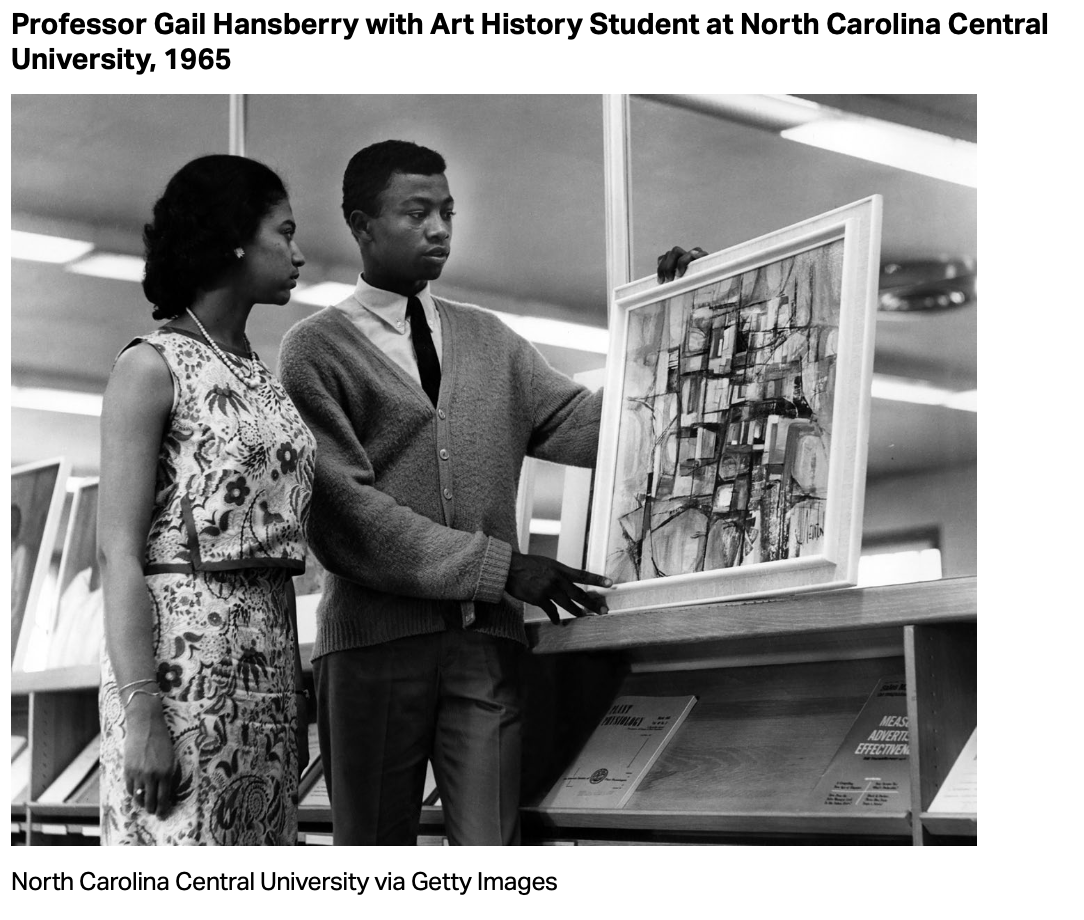
Fostering leaders in various fields
When I first taught this topic, the photograph of Professor Gail Hansberry felt the least intuitive to connect to the essential knowledge points. Over time, however, I’ve found it to be one of the most flexible images for highlighting how HBCUs fostered artistic expression, professional advancement, and cultural leadership. This conversation can lead to showing examples of her artwork and her other professional work.
Research (30 minutes)
I then introduce the assignment. I split up students into groups of four and each will research an HBCU, though no group will do the same HBCU (I draw numbers for the order of groups to choose). All of the requirements for the presentation are in the instructions document. Students are encouraged to prioritize official university websites, alumni profiles, and reputable secondary sources. This reinforces research skills while keeping the focus on institutional history rather than rankings or athletics alone.
A copy of it is embedded below. I give students 30 minutes to do their research and then we move into the 4 minute presentations.
Presentations (30 minutes)
The presentations in my class end up being about 30 minutes of class time. During the presentations I give students a notes chart so that students can take notes on their classmates’ presentations. I include information from their presentations into a future quiz to ensure the audience pays attention. As they present I grade the presentation using the rubric in the instruction page.
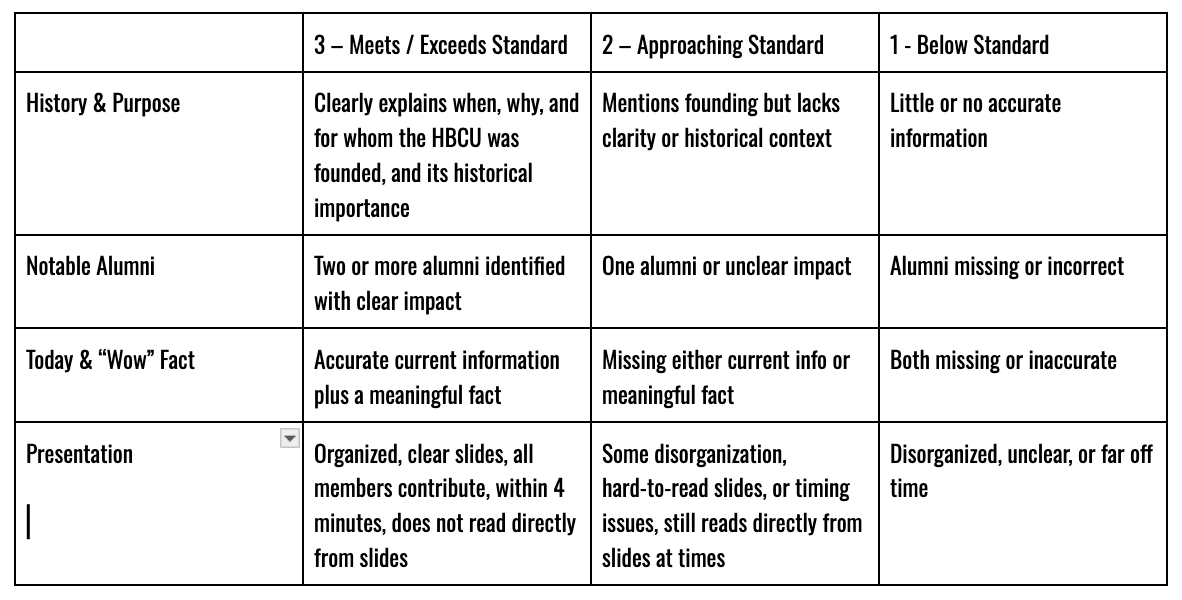
Assignment Rubric
At the end of the presentations I take a poll of the groups and ask which HBCU they would like to apply to. Each group gets one vote and they must vote for an HBCU that’s not their own. I award an extra bonus point to the group that wins the poll. The final poll reinforces the persuasive element of the assignment and creates a low-stakes competitive incentive, while also prompting students to reflect on how institutional missions and histories resonate differently with different audiences.
Differentiation, Modifications, Extension
This lesson is easily adaptable to meet a range of student needs. For classes that benefit from additional structure, teachers can provide a curated list of HBCUs or pre-selected research links to streamline the research process. Presentation expectations can also be modified—for example, reducing the presentation length, allowing note cards, or assigning specific speaking roles within each group to support reluctant speakers. For students who need additional support with synthesis, a guided notes chart or required research categories (history, mission, notable alumni, and present-day impact) can help focus their work. Conversely, advanced students can be challenged to incorporate primary sources, enrollment data, or historical comparisons to predominantly white institutions (PWIs) to deepen analysis. Additionally, there is a PBS video that does a really good job of exploring HBCUs and includes the Black presenters having an honest reflection on whether they would have preferred to attend an HBCU over a PWI.